
José Pizarro has six restaurants in London, all of them Spanish, and a reputation serious enough that food writers who have spent careers eating in Spain describe his cooking as the most honest Spanish food in Britain. He grew up in Extremadura, the spare inland region near the Portuguese border, and moved to London in his twenties. The Spanish Home Kitchen is his sixth cookbook and his most personal: a collection of the food his family cooked, the food he ate in his home region, and the food he has been cooking for the last twenty-five years in a city that is mostly not Spain. The book is dedicated to his grandmother. The dedication is earned.
The case for this book in 2022 is that it updates what von Bremzen did in 2005 without replacing it. Von Bremzen’s New Spanish Table captured a cultural moment — the period when Spain became the world’s most discussed food country and English-language readers were suddenly hungry to understand what all the talk was about. Pizarro’s book is what comes after that moment: the cooking itself, stripped of the context and the explanation, written by someone who never needed to be explained to. Where von Bremzen was a brilliant foreign correspondent, Pizarro is a home cook writing about home. The difference is audible in the recipes.
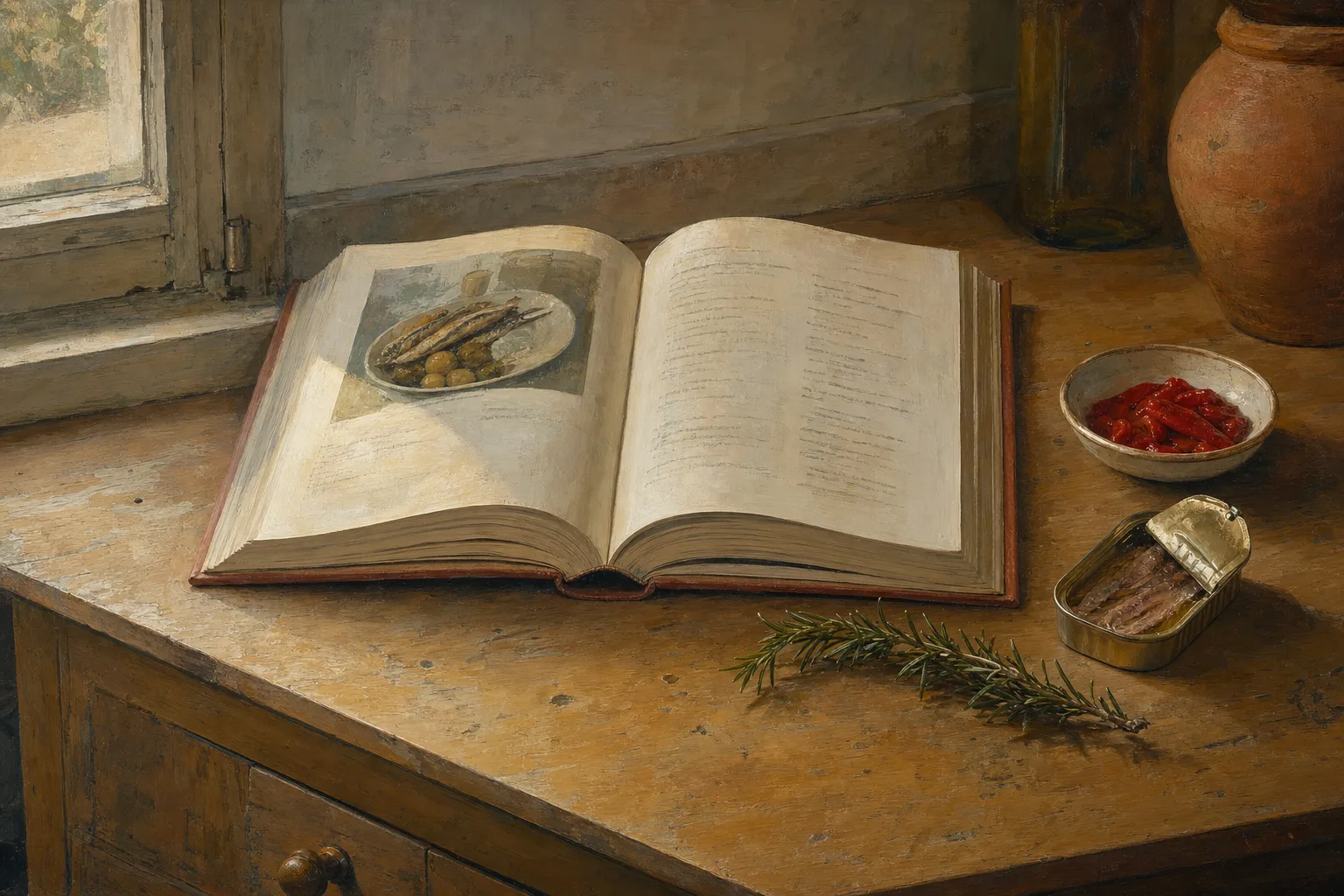
Conservas are present throughout, used the way they are used in actual Spanish kitchens: without fanfare, as a pantry staple whose quality is assumed. A dish of roasted tomatoes and peppers on toast — zorongollo — finishes with capers and anchovies as a matter of course. Fried sardines appear paired with a warm lentil salad, as straightforward as a weeknight pasta. The rice and clams is soupy and salt-forward and requires thirty minutes. None of these recipes have headnotes explaining why tinned fish is good now. They have headnotes explaining where in Extremadura Pizarro’s mother made this dish, which is more useful.
The photography by Emma Lee is restrained and clean — not the overstyled, colorful production of a food trend book, but something closer to how the food actually looks on a table in a Spanish home. This is a deliberate choice and the right one. The recipes are similarly calibrated: tested in a real professional kitchen but written for domestic execution, with the understanding that a Spanish home kitchen and a Michelin-starred restaurant kitchen are two completely different things and neither is trying to be the other.
The comparison with von Bremzen is unavoidable and also not quite fair. The New Spanish Table is a comprehensive survey that argues for a whole country’s cuisine; The Spanish Home Kitchen is a personal cookbook that argues for one person’s relationship to the food they grew up eating. Both arguments are worth making. What Pizarro offers that von Bremzen cannot is the working chef’s practical knowledge — the understanding of why a technique works, why an ingredient is non-negotiable, where a shortcut is acceptable and where it isn’t. The book is less encyclopedic and more useful on a Wednesday night, which is a legitimate trade.
If you buy this book alongside The New Spanish Table, you will have a complete picture of Spanish cooking: one book for understanding the tradition, one for cooking it.
Where to buy
- Amazon Buy at Amazon
- Bookshop.org Buy at Bookshop.org
As an Amazon Associate, The Tin Guide earns from qualifying purchases.